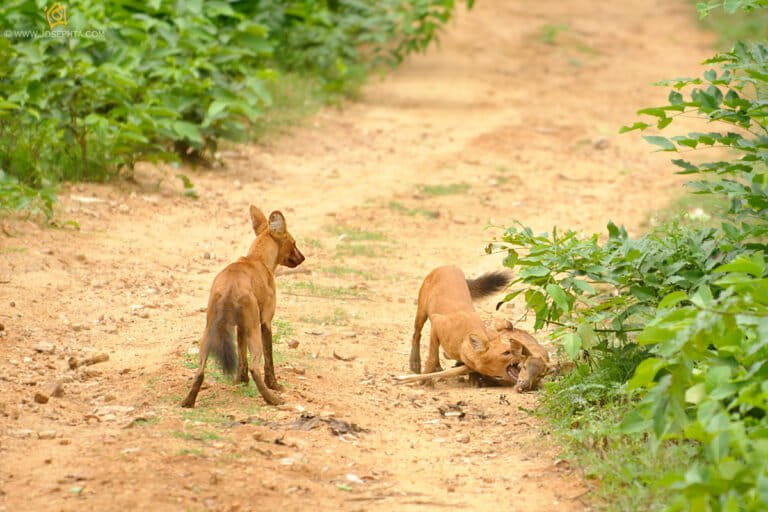
Dholes (Cuon alpinus), also known as Asiatic wild dogs, are among the most threatened carnivores globally and are currently listed as ‘endangered’ by the International Union for Conservation of Nature (IUCN). Understanding what they eat, can offer clues that will aid in their conservation. Researchers have now developed a new technique to analyse their diet by using only “small pinches” of scat material. Non-invasive fecal samples have become increasingly important for studying the diet of elusive and endangered species, as they provide finer taxonomic resolution. But while most recent metabarcoding studies have used methods involving the collection of whole scats in ziplock bags or centrifuge tubes with silica beads, molecular ecologist Abhinav Tyagi and his colleagues took a different approach. While researching dhole diet inside the Tadoba-Andhari Tiger Reserve in Maharashtra, forest staff trained by Tyagi, instead of scooping up entire piles of dhole scat from the ground, collected only “small pinches” of material. Samples were collected during the monsoon (August-September 2022) and winter (January-February 2023). The study, published in Environmental DNA, is a collaboration between the National Centre for Biological Sciences (NCBS) and the Maharashtra Forest Department, and uses “DNA metabarcoding to assess spatial and seasonal variation in dhole diet from a high-density dhole landscape.” Researcher Abhinav Tyagi collects a dhole scat sample during field research in Tadoba-Andhari Tiger Reserve. A new technique has been developed to analyse diet by using only “small pinches” of scat. Image courtesy of Abhinav Tyagi. “The study found, their diet, irrespective of season,…This article was originally published on Mongabay