
For Mehak (name changed), 28, a resident of Srinagar’s Bagh-e-Mehtab, the absence of a regular water supply has turned a basic necessity into a daily struggle. “Every morning, I wake up hoping that there will be a regular water supply, but there is never any certainty,” she said. “For the past few years, we have struggled to get enough water for bathing, washing clothes and other basic needs. We have installed three tanks at home, but even that is becoming expensive. There is no fixed timing for the water supply, and sometimes the water we get is not clean.
“The constant uncertainty has taken an emotional toll on my mother. She becomes stressed and her mood changes because every day begins with the same worry whether we will have enough water,” Mehak said.
Zamrood, 60, a resident of Srinagar’s Pir Bagh, explained,“Water supply becomes extremely erratic during summer, with low flow and taps sometimes remaining dry for up to four consecutive days.“ Over the past few years, the situation has become terrible. As summer temperatures rise, the water supply nearly disappears, making it difficult to meet even basic daily needs. Even households of two or three people do not receive enough water.
To cope with the shortage, Zamrood said local waterworks staff and neighbours advised her family to install a hand pump to access groundwater when pipeline supplies run dry. The family also installed additional Sintex tanks at ground level to store water for emergencies. “Having this additional storage and a hand pump has helped us manage during periods of water shortage,” she said.
The storage tanks allow the family to reserve water for times of need, while the hand pump provides access to groundwater when the pipelines run dry during adverse weather conditions.
Amid rising heat and missing snow, Kashmir is racing to adapt
Living with water scarcity
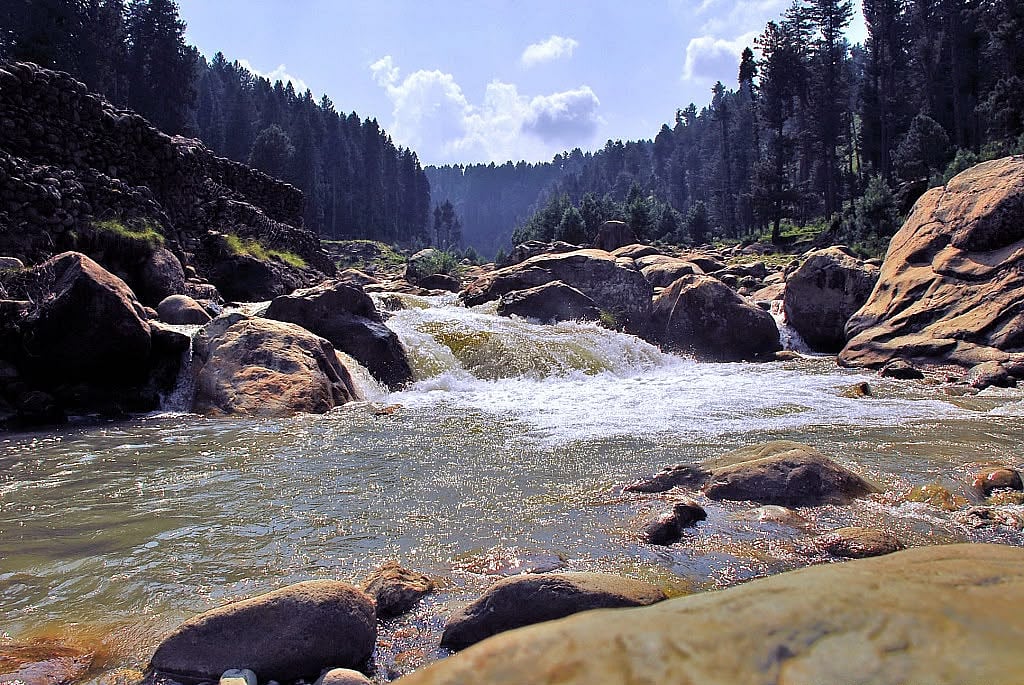
Doodh Ganga is a vital source of drinking water for much of uptown Srinagar. Doodh Ganga, also known as Chazz Kul, is a tributary of the Jhelum River. It originates from the Pir Panjal glaciers near Tattakoti mountain peak, at an altitude of around 4,500 metres, with its initial stretch fed by glaciers, springs and snow-fed lakes. The river flows for about 45 kilometres through the valleys of Budgam and Pulwama before reaching Srinagar.
Climate change is adding pressure on Doodh Ganga. “But rising temperatures, changing rainfall patterns and declining snowmelt is affecting the river’s water availability, while intense rainfall and cloudbursts could increase flooding and contamination,” Raja Muzaffar Bhat, founder of the J&K RTI Movement and Chairman of the J&K Climate Action Group.
A 2024 study Inventory and status of glaciers in the Pir Panjal Range Kashmir basin between 1980 and 2020 published in the International Journal of Hydrology Science and Technology highlighted the dramatic loss of glaciers in the Pir Panjal range. The study revealed that 122 glaciers have shrunk from 25.7 square kilometres in 1980 to just 15.9 square kilometres in 2020. South-facing glaciers are melting faster than their north-facing counterparts, with those situated between 3,800 and 4,000 metres, experiencing the most significant retreat.
The signs of climate change affecting Doodh Ganga are “very loud and clear”, said Shakil Romshoo, earth scientist and vice chancellor, Islamic University of Science & Technology (IUST). Kashmir Valley has 24 watersheds, including Doodh Ganga. The impacts of climate change are broadly similar across Kashmir’s watersheds, whether in central Kashmir, Budgam, Anantnag or Baramulla, he said. “We are experiencing high-intensity rainfall and, at times, flash floods. During winter, snowfall is decreasing.”
Four or five decades ago, there was much more snowfall in the upper reaches of Doodh Ganga, but that has declined, Romshoo noted. “Winter temperatures are also rising, particularly in February and March, and when snowfall does occur, it begins to melt quickly.”
Kashmir’s melting glaciers are feeding lakes that villagers know well — but have not been warned about
Disrupted water cycles
The changing snowfall and temperature patterns are already affecting Kashmir’s water availability. “Earlier, winter snow would remain frozen for several months and melt gradually from April through July, providing water during the summer. But with declining snowfall and warmer winter temperatures, snow is now melting much earlier, often in February and March,” Romshoo said.
Illegal construction on the river’s catchment area has added to these pressure. In Srinagar, the river’s natural course was divided into two channels, one flowing into a wetland and the other passing through Alochi Bagh and Batamaloo before joining the Jhelum. Over the past three decades, the Batamaloo channel was gradually buried under concrete structures, parks and bus stops. During the September 2014 floods, floodwaters followed the same low-lying route, inundating the area from Batamaloo to Qamarwari.
“The reduced flow in Doodh Ganga has already affected water supply, particularly during dry periods,” said Anbreena Anjum, superintending engineer, Jal Shakti (water resources), Public Health Engineering Dept (PHE) Kashmir. “In 2024, we experienced a severe shortage of raw water in Doodh Ganga because Kashmir witnessed an overall precipitation deficit of nearly 80 percent. The discharge in Doodh Ganga was significantly low that year, and we experienced interruptions in water supply. ”
Dry taps and vanishing springs: Kashmir faces water stress as Himalayan snowpack shrinks
“The Doodh Ganga water treatment plant has a capacity of 45.5 million litres per day (MLD) and supplies drinking water to more than 200,000 people across uptown Srinagar, including Bagh-e-Mehtab, Kralpora, Pirbagh, Hyderpora, Sanat Nagar, Baghat, Barzulla, Rambagh and areas up to Hari Singh High Street,” Anjum said. “During lean periods, when the natural flow in the water bodies decreases, we have to depend on a lift station at Kralpora to supplement the raw water reaching the plant from Nauhar. Heavy rainfall and cloudbursts can also disrupt supply because the water becomes highly turbid and muddy, forcing us to temporarily shut the plant to prevent damage or choking of the filtration system. So, both prolonged dry periods and extreme rainfall events can affect the reliability of water supply from Doodh Ganga.”
“When the Nauhar water line dries up in the upper catchments and the flow reduces during the lean period, we become dependent on the pumping station at Kralpora,” Anjum noted. The department, she added, makes temporary arrangements to divert the available flow towards the pumping station to maintain supplies.
Anjum further explained, climate change could make the challenge more difficult. “We cannot keep finding alternative sources of water every time, particularly as climate change is causing increasing water stress, adding that irregular rainfall, extreme cloudbursts and prolonged dry periods could create both floods and water shortages. The department is planning water-supply and conservation measures for the next 30 to 40 years, including improving catchment areas and promoting water reuse.”
The author of this article is a mentee at the Asian College of Journalism’s Climate Change Hub, funded by Interlink Academy, Germany.