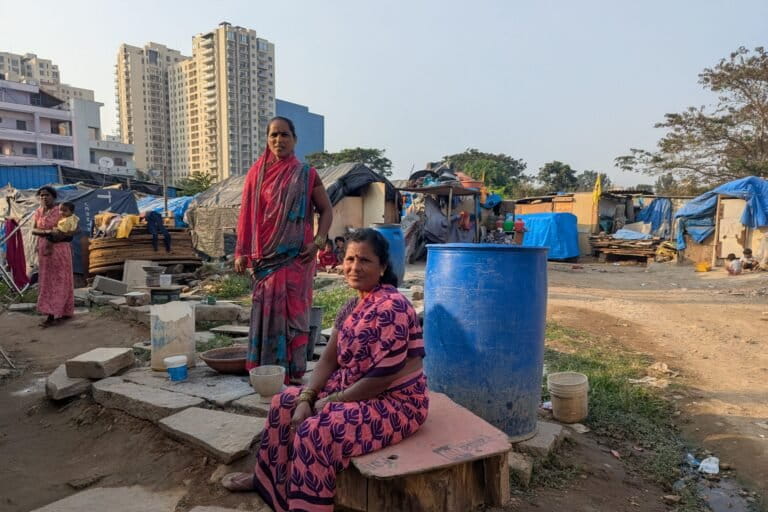
Sisters Rekha, 40, and Ratnamma. T, 50, left their village in Raichur, Karnataka, over a decade ago with their three children each. They had no work back at home. They were confident they would find something to do in Bengaluru, which registered a population growth of 40% between 2001 and 2011 to 8.5 million people. Today, an estimated 14.8 million people live in the city. They became domestic workers and found a house in Maruti Layout on the banks of Anchepalya Lake in Jakkur, north Bengaluru. The dwelling, roughly 8×8 feet, has three brick walls and a roof made of materials including tarpaulin, metal boards, and corrugated cement sheets. Similar houses surround their densely packed neighbourhood. Neither sister is fond of the nip in the air or the monsoons. The winters are too cold, and the summers too hot. When heavy rains arrive, the water from Anchepalya Lake pours over into the dusty pathways of the low-lying Maruti Layout. Freshwater, sewage and sludge mix. Mosquitoes breed. Infections and diseases follow. Karnataka State Action Plan on Climate Change states that climate change means Bengaluru will have hotter summers, heavier rainfall, and more frequent drought. Ratnamma is already feeling these effects. “In the summer, we can’t sleep. We sit out until midnight, hoping that a little breeze will cool us down. And during the rain, we can’t sleep because there’s water and mosquitoes everywhere,” she says. “We are all migrants,” says Siji Chacko, Climate Innovations, Migrants Resilience Collaborative (MRC). “But what separates us…This article was originally published on Mongabay