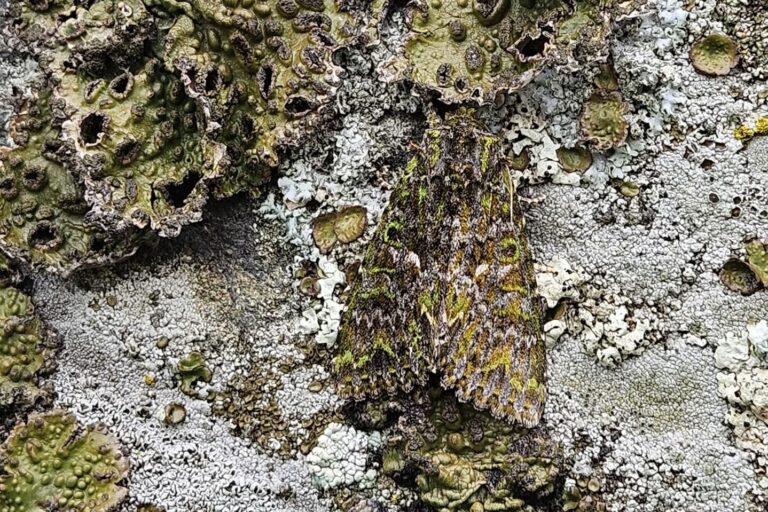
A new paper documents the first known record of a moth using the umbilicate lichen, Lasallia pertusa, as a camouflage background. Published in the journal Arthropod-Plant Interactions, the observation was made in July 2025 at Duggi, in Kugti Wildlife Sanctuary, Chamba district, Himachal Pradesh, at about 3,200 m elevation. Lichen-associated camouflage has been documented before, including in moths. In this case, however, the association involves an umbilicate (attached to its substrate only at a single point), foliose (with flat, leaf-like lobes) lichen, rather than the more commonly documented crustose or bark-growing lichens. The finding, therefore, expands the range of lichen growth forms known to potentially participate in insect camouflage. It also points to the fact that a seemingly inconspicuous lichen can be an important part of an animal’s visual environment and survival strategy. One of the authors, Sanjay Kumar Unniyal, informs Mongabay-India that though there have been similar observations of moths mimicking lichens in the past, this particular lichen species has been documented for the first time. “This might have an evolutionary consequence which can only be understood through further studies,” Unniyal shares. L. pertusa has a large, perforated and highly irregular thallus (vegetative body), providing a particularly complex visual background, reports the paper. The moth that belongs to the family Noctuidae, was found resting directly on the lichen growing on exposed rock. The moth’s identification was based on photographs and expert examination. The paper reports that the moth species couldn’t be identified due to the absence of a specimen.…This article was originally published on Mongabay