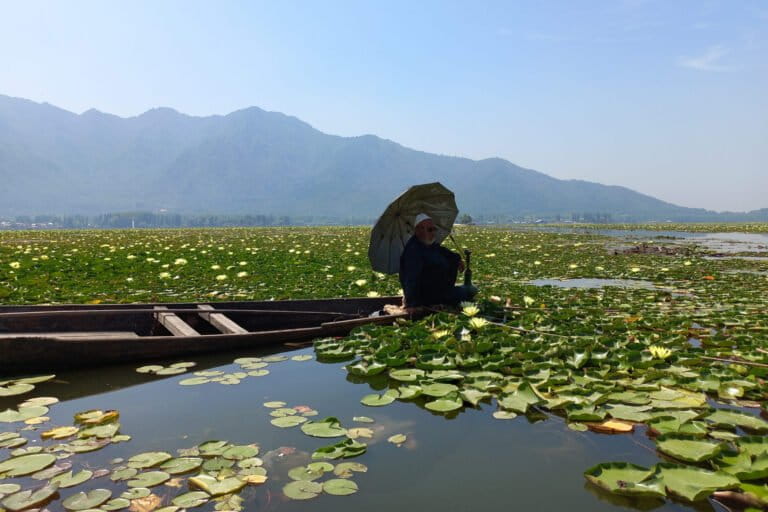
The uncontrolled growth of aquatic plants has become a major environmental challenge in Dal lake, an important freshwater lake in the Kashmir Himalaya. A new study has tested a way to convert these excess plants into fermented liquid fertilisers, offering a potential solution to manage weed overgrowth while producing a useful agricultural input. Dal, a culturally and ecologically important lake in Kashmir, has been showing visible symptoms of eutrophication, with runoff from surrounding areas, untreated sewage, and other pollutants adding excess nutrients to the lake and leading to the rapid growth of aquatic plants. While aquatic vegetation can be useful as food, medicine, and fodder, overgrowth disrupts water quality, alters ecohydrology, and threatens native biodiversity. “While the overgrowth of aquatic plants and algae blooms follows a seasonal cycle, the underlying decline in water quality is palpable year-round. We’ve seen the lake struggle under the weight of these excess nutrients, which is exactly why we are focused on repurposing that biomass into something useful for our land,” Kowsar Majid, one of the study authors and a professor in the department of chemistry at National Institute of Technology, Srinagar, told Mongabay-India. The study was published in ACS Sustainable Resource Management journal in March 2026. The findings are a proof of concept, with further studies needed to assess costs, large-scale feasibility and regulatory approval before the approach can be adopted widely. Majid explains that most previous work on Dal lake biomass has focused on solid soil amendments such as compost, vermicompost or hydrochar.…This article was originally published on Mongabay