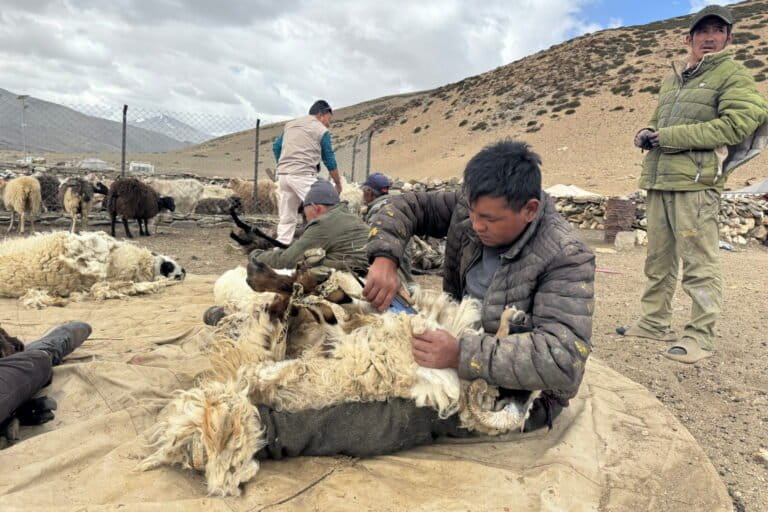
Tsering Namgayal walks with a herd of Pashmina goats across the Debring plains of the Changthang plateau in Ladakh. The land stretches wide under the bright sun, as a cold wind sweeps across this trans-Himalayan high ground. Dust rises in small clouds over the herd as the goats, also known as Changthangi goats, tap the frozen ground and bleat. The air carries the scent of soil, grass, and pashmina wool. This visibly harsh and cold landscape has sustained the Changpas, the nomadic pastoralists of Changthang, for centuries. Their lives are intertwined with the changing seasons and movement of herds. However, these seasonal patterns are now changing. Namgayal pauses during a grazing halt alongside other herders. Among them is Tobgah Dorjee, who is preparing to leave Changthang, possibly forever. Tobgah plans to sell his 54 Pashmina goats and move to Leh, where he hopes to find work as a construction labourer. Between March and April 2025, Tobgah lost 80 Pashmina goats to extreme weather. Several Changpa families from the nearby Puga Valley were migrating towards Kharnak, a seasonal movement, when unexpected heavy snowfall buried the grazing grass. An extreme cold spell killed newborn goats, shrinking herds within days and turning a routine journey into a struggle for survival. Spread across 35,000 square kilometres, Changthang, that spans Ladakh and Himachal Pradesh in India as well as Tibet, is home to a scattered population of pastoralists who depend primarily on pashmina wool and dairy products obtained from the goats, for their livelihood. Across…This article was originally published on Mongabay