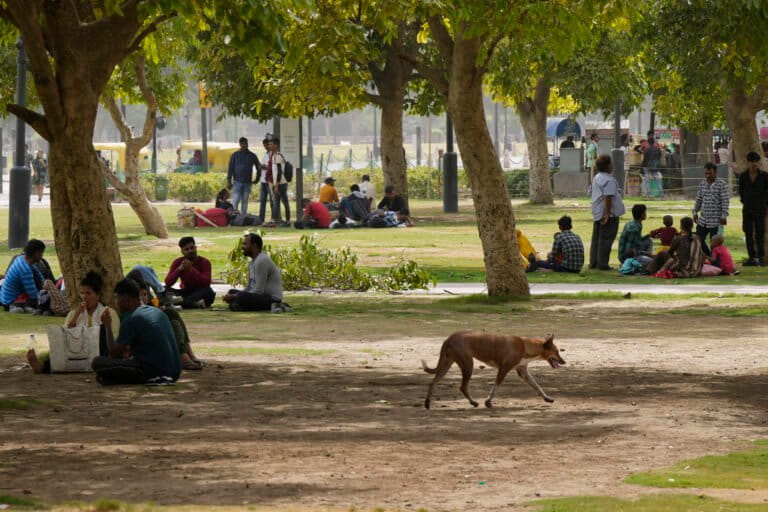
Urban greening is widely promoted as a solution to rising temperatures. But can planting more trees actually make people feel hotter in some cities? A new study published in Nature Communications by researchers from IIT Gandhinagar and Northeastern University, USA examines this paradox. Instead of looking only at air temperature or land surface temperature, the study focused on the Heat Index (HI) which is the “feels like” temperature that combines heat and humidity because humans respond to both temperature and moisture in the air. The study finds that while urban trees generally help cool cities by providing shade, reducing incoming solar radiation, and lowering surface temperatures, these benefits vary in different cities. In humid cities, dense tree canopies can inadvertently increase heat stress by boosting evapotranspiration, which releases more moisture into the air. Where buildings are closely packed and airflow is restricted, this extra humidity can raise the Heat Index even if the air itself becomes cooler. On the other hand, semi-arid cities experience more consistent cooling because the drier atmosphere can absorb additional moisture without becoming uncomfortably humid. The study’s first author, Angana Borah, says the same tree can produce very different thermal comfort outcomes depending on where it is planted, the surrounding urban density and the local climate. As cities warm faster than their rural surroundings, climate-responsive greening is important, the study notes. Canopy structure plays a role The study analysed three different aspects of vegetation — EVI (Enhanced Vegetation Index), LAI (Leaf Area Index) and fPAR (Fraction…This article was originally published on Mongabay