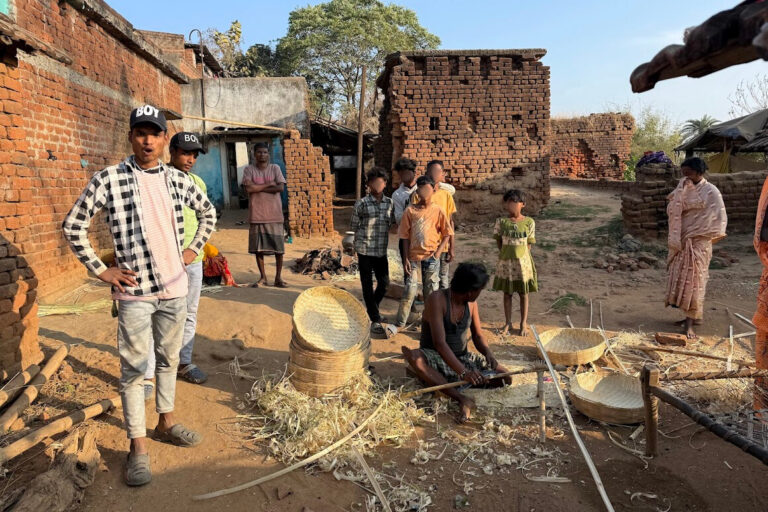
At sunrise, the courtyards of Mohuli village, an artisan hamlet in Dumka district of Jharkhand, resonate with the rhythmic rasping of dry bamboo being sliced. Buddhan Mohuli (65) sits cross-legged on a fraying jute sack, his toes gripping a curved blade. With each steady pull of his hand, a bamboo strip thins into fine, uniform threads. The village is known for a traditional bamboo slicing method using feet. “We start around 4 am,” he says, eyes fixed on the strip. “By afternoon, the fingers stop listening.” A full day’s work earns him ₹100–₹200. Similar scenes play out across other villages such as Kathikund, Ramgarh and Thengi More in Jharkhand. Senior artisans Gultan Mohuli and Khoda Mohuli say that the foot-based slicing technique wastes almost nothing. The bamboo splits clean, yielding fine, flexible slivers that bend without breaking. Artisans learn to control these movements over the years, shaping the rhythm of the craft with their bodies before their hands fully master it. “This kind of work can only be understood with the feet,” Arjun Mohuli, a senior artisan from Thengi More, explains. The artisans make diverse bamboo products: large winnowing trays for sorting grains; flat trays to dry mahua flowers; big baskets to store vegetables; thick-rimmed baskets to carry heavy loads; and curved mats line kitchen shelves. Each object reveals deep traditional knowledge shaped over time. Women sell tokris and soops (bamboo crafts) at a weekly haat in Godda district. Artisans in Mohuli village, Dumka district, Jharkhand, make diverse bamboo products…This article was originally published on Mongabay