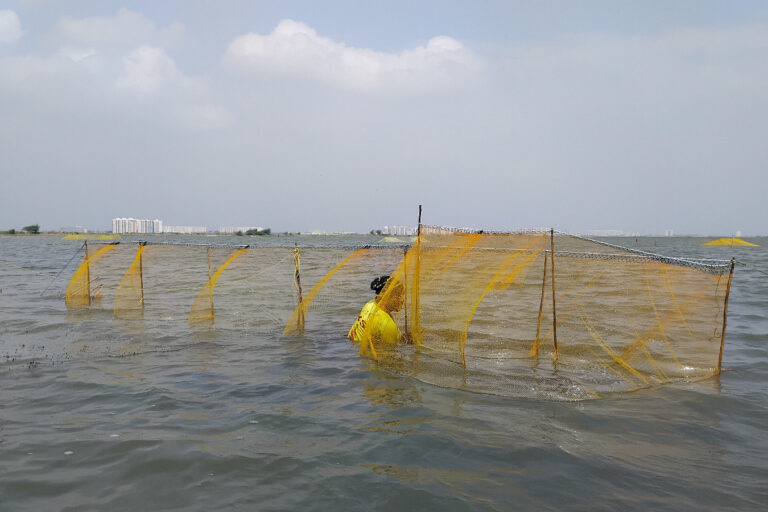
Narayanan R. stood on the muddy bund of the Great Salt Lake, watching a group of flamingoes pick their way across the shallows. He remembered standing in the same spot as a 10-year-old, knee-deep in water — the day his father showed him how to fish. “The flamingoes may not come next season,” he said. “These pools will dry soon. A few hundred metres away, Gowriamma waded through the shallow waters of the lake, her fingers sifting through the mud for shrimp. “Everything depends on these small pools. We know this water through the mud and the thorns.” Located between Nemmeli and Kovalam in Chennai, the Great Salt Lake also known as Kovalam-Nemmeli backwaters, is a coastal wetland that spans 5,000 acres. The Tamil Nadu government plans to convert this coastal wetland into Chennai’s sixth drinking water reservoir: the Mamallan reservoir. Chennai currently supplies between 700 and 800 million litres per day (MLD) of water. The demand already exceeds 1,100 MLD and is projected to cross 2,500 MLD by 2035, according to the project’s environmental impact assessment (EIA). The Mamallan reservoir aims to supply 170 MLD for the city’s needs. The reservoir is designed to store 1.65 thousand million cubic feet (TMC) in a single filling and an annual storage of 2.25 TMC. However, for Narayanan, Gowriamma and many fishing families in the area, losing the Great Salt Lake means losing the only world they have ever known. “Who are we to change the contours drawn by nature?” Narayanan asks.…This article was originally published on Mongabay