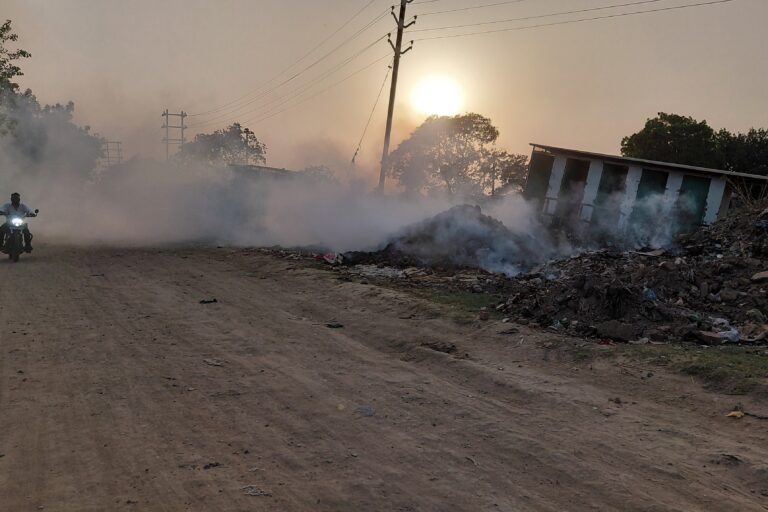
In the peak of summer, villages around Koilwar and Arrah in Bihar’s Bhojpur district are often hit by dust storms. By midday, strong winds sweep fine soil across agricultural fields, leaving crops and rooftops coated in dust. But the dust seen in summer is only the beginning. For local communities, air pollution typically worsens after the monsoon into the winter months when temperatures plunge, and ground-level wind speeds drop to near-stagnation. It prevents dust and emissions from industries and households from dispersing easily. As a result, pollutants accumulate near the ground, causing air quality to deteriorate. Vishwanath Pratap Singh, a local social activist based in Bhojpur, says, “During the summer, we somehow manage the heat and dust storms, which are challenging but still manageable. But the real disaster unfolds during the winter months when a strange heaviness grips the village air. “Persistent eye irritation and chronic throat infections have now become a daily reality for our children and the elderly,” he adds. Aamod Kumar, a resident of Koilwar, says the air becomes unbearable in winter. “Once the brick kilns start operating, the whole area fills with smoke, especially in the mornings. Ash settles on our crops, affecting the harvest. Stepping outside feels like breathing smoke instead of fresh air.” The concerns expressed by Aamod and Singh are not an isolated experience. It is supported by findings from a study conducted by Indian Institute of Technology (IIT) Kanpur. Under the project named the AMRIT (Ambient Air Quality Monitoring over Rural areas using…This article was originally published on Mongabay