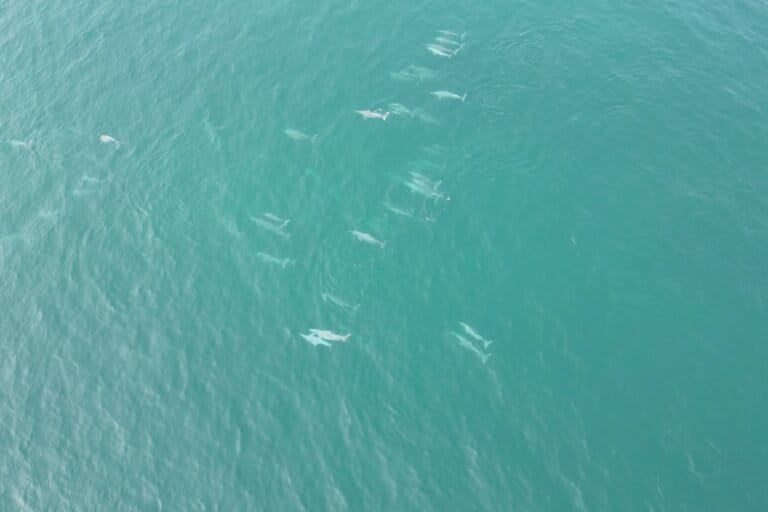
The Arabian Sea was listless as we headed out one morning to spot Indian Ocean humpback dolphins, famously extroverted and known for their acrobatics. A needlefish darted across the surface, pirouetting over the chop as the sun beat down on the deck, turning the railings hot to the touch. When you stare at the ocean long enough, your mind starts to play tricks: every shifting shadow looks like a flipper, every cresting wave, a dorsal fin. Then a shape appeared. To my untrained eye, it looked like a dolphin. But Imran Samad, a Ph.D. researcher at the Centre for Ecological Sciences at the Indian Institute of Science, whose work focuses on marine megafauna bycatch in India’s multi-gear fisheries, leaned forward over the roar of the outboard engine and said, “It’s a porpoise.” It was a blink-and-you-miss-it moment. The animal surfaced for barely a second before vanishing back into the brown water. And that, as Samad would explain over the course of the morning, is precisely the problem — not just for researchers trying to spot them, but for the conservation of a species that most of India does not know exists in these waters. An animal built for invisibility The Indo-Pacific finless porpoise (Neophocaena phocaenoides) is one of the smallest cetaceans in Indian waters, measuring just 1.5 to 1.9 metres in length and weighing 30 to 45 kilograms. It belongs to the family Phocoenidae — an entirely different lineage from dolphins — and the differences run deeper than the obvious…This article was originally published on Mongabay