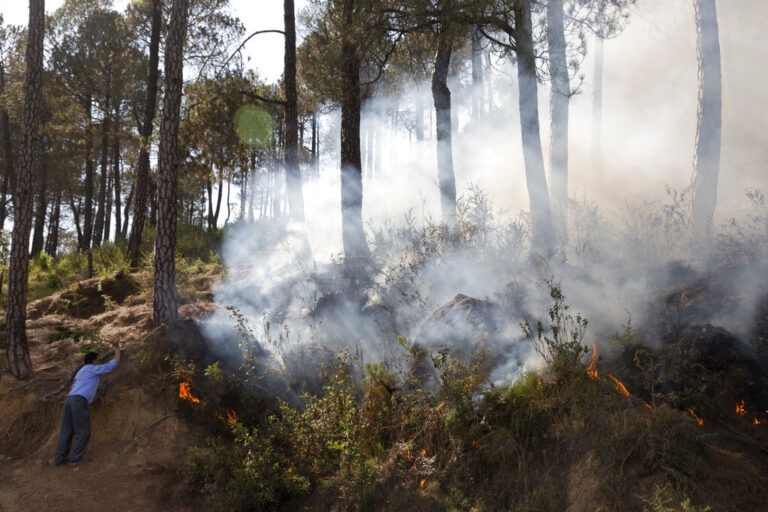
Concerns about rising forest fires in India, with reports of Himalayan forests catching fires outside their typical season, are supported by recent research from India’s biodiversity hotspots, the Himalayas and Western Ghats, which warn of their ecosystem-level impacts. Scientists in India are increasingly reporting about the potential risk to ecosystems caused by more frequent forest fires. These include two recent studies, one in the western Himalayan state of Uttarakhand, in the journal Trees Forests and People, and research on the impacts on a savannah system, using the example of Satyamangala Tiger Reserve in the Western Ghats, published in the journal Next Sustainability. A separate September 2025 study in Environmental Sciences Europe says the forest fire season has expanded in India, with events occurring during the dry pre-monsoon period from February to June, peaking in March and April. Spatial patterns indicate an increased vulnerability to forest fires due to dense forest cover and increasing climatic variability, in central India, the Himalayan foothills, the Western Ghats, and the Eastern Ghats, it says. Another 2024 report in Frontiers in Forests and Global Change describes loss of carbon stocks due to forest fires in Uttarakhand. A forest fire in Uttarkashi in 2016. Image by PJeganathan via Wikimedia Commons (CC BY-SA 4.0). The recent Uttarakhand study in Trees Forests and People, “moves beyond general observations by providing precise, depth-wise quantification of nutrient loss across different forest types,” says Himanshu Bargali, scientist studying the economics of ecosystems and biodiversity under a UNEP-funded project at the Indian…This article was originally published on Mongabay