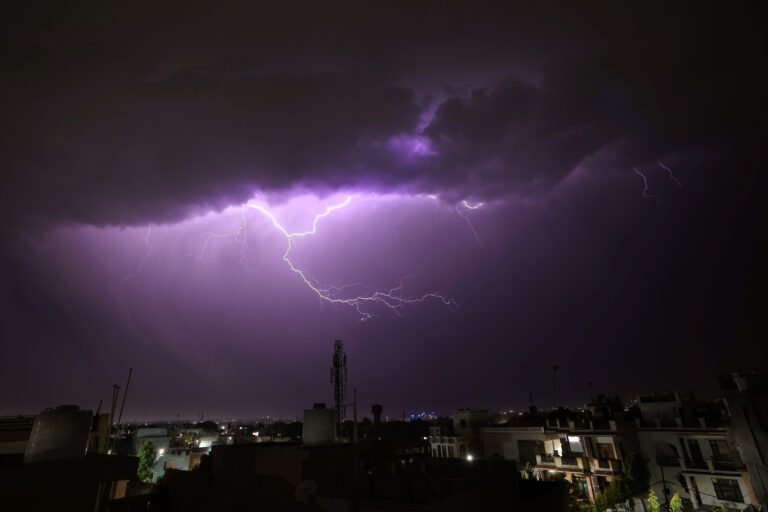
Lightning is among India’s deadliest natural hazards, accounting for nearly 40% of all natural disaster-related deaths each year, according to the National Crime Records Bureau. While rising temperatures and stronger convection linked to climate change are known to influence lightning activity, a new study points to air pollution as another key factor shaping how lightning forms inside clouds. The study, published in Journal of Geophysical Research: Atmospheres, examines how aerosols, tiny particles suspended in the air from both human and natural sources, modulate lightning activity across different regions of India. According to the authors, air pollution can both enhance and suppress lightning, depending on pollution levels, particle size, and regional meteorological conditions. How pollution influences lightning Subhojit Ghoshal Chowdhury, the lead author of the study, from the Centre for Atmospheric Sciences at the Indian Institute of Technology Delhi, says the relationship between air pollution and lightning is not linear. “Our study shows that air pollution can both increase and decrease lightning, depending on how polluted the air is and what kind of particles are present,” Chowdhury explains. He notes that when pollution levels increase moderately, lightning activity intensifies. “Tiny pollution particles, or aerosols, act like seeds, creating many small cloud droplets that get lofted high into the atmosphere. There, they freeze into ice crystals and graupel (soft hail), and collisions between these ice particles generate electrical charge; lightning occurs.” However, Chowdhury adds that this process reverses when pollution becomes excessive. “When pollution becomes too high, excess particles disrupt the cloud’s…This article was originally published on Mongabay